
Are gabapentinoids the best medication for restless legs syndrome?
If you require medication for your RLS then gabapentinoids are likely to be the first line therapy.
Gabapentinoids for the restless legs syndrome
Alpha-2-delta ligands (Gabapentinoids) as a class of medication is now considered the first-line treatment (recommended by the American Academy of Sleep Medicine and the 2026 "An updated algorithm for the management of restless legs syndrome") for RLS because they help with both the physical sensations of RLS and the sleep disturbances associated with the condition. At therapeutic doses Gabapentinoids are successful in treating 70% of patients. Patients with comorbidities of chronic pain, psychophysiologic insomnia, or anxiety may obtain additional benefit from gabapentinoids. Gabapentin, Gabapentin enacarbil and Lyrica are three Gabapentinoid medications. There are circumstances when Gabapentinoids are contraindicated. A list of contraindications is at the end of this page under the heading "Contraindications for gabapentinoids".
Gabapentin (Neurontin) for the restless legs syndrome
Unlike dopamine agonists (e.g. Sifrol) that act like a "gas pedal" for the brain's reward system, Gabapentin functions more like a volume knob, reducing down the overactive sensory signals in the legs. If the RLS includes sensations that feel like burning, aching, or "electric shocks," Gabapentin is particularly effective because it was originally designed to treat nerve pain. One of the biggest perks of Gabapentin is its sedative effect. While Sifrol helps the urge to move, Gabapentin often helps you actually stay asleep once you get there.

Gabapentin is very closely related to pregabalin (see below). They are both gabapentinoids and both used to treat moderate to severe chronic RLS. While they work similarly by modulating calcium channels in the nervous system to "calm" overactive signals, gabapentin has a few unique quirks regarding how the body absorbs it. At a small 300 mg dose, the body absorbs about 60% of the drug. If you step up to a 1,200 mg dose, absorption plummets to roughly 35%. This causes unpredictable blood levels between different people.
Figure 1: Gabapentin chemical structure
Gabapentin is a good treatment alternative for RLS as it has:
-
Minimal augmentation: It carries a very low risk of making RLS symptoms worse over time, unlike older dopamine drugs.
-
Pain relief: It is particularly effective if the RLS is accompanied by "burning" or "tingling" sensations (neuropathic pain).
-
Cost: Generic gabapentin is generally very affordable, though the Enacarbil (Horizant) version can be more expensive.
Standard gabapentin (Neurontin) is not officially approved by the TGA in Australia or the FDA in the United States for RLS. It is prescribed off label.
Gabapentin dosing
Because generic gabapentin features a strict absorption bottleneck in the gut, its dosing strategy for RLS is highly individualized requiring careful clinical titration to find the specific point where symptom relief is achieved without triggering daytime side effects. Standard protocols suggest starting with a very low dose (e.g., 100 mg to 300 mg) in the evening and slowly increasing it by 100 mg to 300 mg increments every few days until the "urge to move" subsides. For the majority of patients, the effective dose settles between 600 mg and 900 mg daily taken in the evening. In some cases with highly severe or refractory RLS doses may scale up to a maximum of 1,800 mg to 2,400 mg daily. The body's ability to absorb generic gabapentin drops sharply at these higher doses.
Immediate-release gabapentin reaches its peak level in the blood roughly 2 to 3-hours after ingestion and clears the system relatively fast. Therefore, timing must be aligned with an individual's specific symptom pattern. If symptoms only trigger when trying to fall asleep, the entire dose is taken roughly 2 hours before lying down. For patients whose legs begin to act up earlier in the day, such as during an evening commute or while sitting on the couch after dinner, the daily dose is split by taking a smaller dose (e.g., 300 mg) around 4:00PM to 5:00PM, followed by the remaining maintenance dose (e.g., 600 mg) right before bed.
Over-the-counter antacids containing aluminum or magnesium (like Mylanta) severely interfere with the absorption of generic gabapentin. The medication must be taken at least 2-hours apart from any antacid to ensure it actually enters the bloodstream.
Box 1: Gabapentin side effects
-
Grogginess, heavy drowsiness (Somnolence): Can happen during the day if a large dose is taken before bed.
-
Fatigue: A general feeling of tiredness or low energy.
-
Mood disturbance: Potential to trigger or worsen depression, mood instability, and suicidal ideation
-
Unsteadiness: Mild dizziness or coordination issues affects roughly 15% to 20% of patients.
-
Cognitive effects: Occasional "word-finding" difficulties or mild forgetfulness.
-
Weight gain: Approximately 20% of patients may have increased appetite or fluid retention.
-
Kidney function: Gabapentin is cleared exclusively by the kidneys. If there is any reduction in kidney function gabapentin doses must be drastically lower to avoid toxic accumulation.
Gabapentin enacarbil (Horizant)
Gabapentin enacarbil is FDA-approved specifically for moderate-to-severe primary RLS. However it is not approved in Australia by the Therapeutic Goods Administration (TGA) for RLS and is generally unavailable through Australian pharmacies. The tablets are engineered with a specialized extended-release matrix. Gabapentin enacarbil is designed to treat RLS with a longer duration of action. It is absorbed more consistently by the gut than generic gabapentin and stays in the bloodstream longer, providing more stable relief throughout the night.
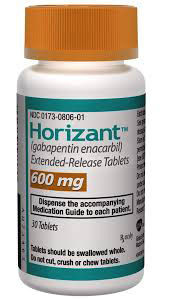
Figure 2: Horizant tablet bottle
Gabapentin enacarbil dosing
Unlike many neurological medications, patients start directly on the therapeutic 600 mg dose without a step-up phase (provided kidney function is normal). The tablet is taken once daily with food. It must be taken with food. Taking it on an empty stomach drastically cuts how much of the medication your body absorbs, making it significantly less effective. Because it takes 5 to 8-hours to reach peak levels, taking it at 5:00PM ensures that the active drug slowly floods the nervous system right at bedtime maintaining a steady, flat ceiling of protection that keeps the legs quiet until sunrise. It has been shown that there is no added benefit to higher doses. No gradual tapering schedule is required when discontinuing the medication for RLS.
Note: The tablet must always be swallowed whole. Crushing, chewing, or splitting it destroys the extended-release mechanism, flooding the system with the drug all at once and risking severe side effects.
Potential gabapentin enacarbil side effects
Because Gabapentin enacarbil relaxes the central nervous system, the most common side effects are generally mild and clear up within a few weeks as the body adapts. Potential side effects include:
Box 2: Gabapentin enacarbil side effects
-
Sleepiness / Drowsiness (Somnolence): Somnolence Impacts up to 27% of patients. While this can actually help RLS patients fall asleep, the grogginess can sometimes spill over into the next morning. For about 70% of patients, this daytime sleepiness improves or resolves entirely within 3 to 4 weeks of continuous use.
-
Dizziness or a feeling of unsteadiness: Occurs in roughly 13% to 22% of patients. This is typically most noticeable when first starting the medication or if the dose is changed.
-
Mood disturbance: Potential to trigger or worsen depression, mood instability, and suicidal ideation
-
Weight gain: Approximately 20% of patients may have increased appetite or fluid retention.
-
Mild fatigue: Affects about 7% of individuals.
-
Nausea: Occurring in approximately 7% of cases.
Pregabalin (Lyrica) for the restless legs syndrome
Pregabalin (Lyrica) has emerged as a cornerstone first-line medication in the management of RLS. In fact, as of the updated 2025 clinical guidelines, it, along with other gabapentinoids, is now widely considered the first-line pharmacological treatment for moderate to severe RLS, replacing older dopamine-based therapies (e.g. Sifrol) for many patients. Pregabalin is not officially approved by the Therapeutic Goods Administration (TGA) in Australia or by the FDA in the United States for RLS.
Pregabalin mode of action is that it binds to specific subunits of voltage-gated calcium channels in the central nervous system. By blocking these channels, it reduces the release of excitatory neurotransmitters (the chemical messengers that tell your nerves to fire). For RLS, this action dampens the uncomfortable, creeping, or pulling sensations in your legs and reduces the irresistible urge to move them.
Advantages of Pregabalin include:
-
No Augmentation: It carries a very low risk of making RLS symptoms worse over time, unlike older dopamine drugs.
-
Predictable and Efficient Absorption: Unlike its close relative, gabapentin, pregabalin is absorbed very rapidly and completely by the body. The amount that gets into the system relates predictably with the dose given, making it easier for a doctor to fine-tune dosages.
-
Dual Benefits for Sleep and Mood: Because it relaxes the central nervous system, pregabalin is highly effective at improving sleep quality and duration. It is also independently used to treat anxiety and nerve pain, making it an excellent "two-in-one" option if your RLS is accompanied by bedtime anxiety or neuropathy.
-
Increase Deep Sleep: Unlike many sleep aids, pregabalin increases "slow-wave sleep" (the deep, restorative phase of sleep), helping with the daytime fatigue often caused by RLS.
-
Physical Sensations and Periodic Limb Movement Syndrome: Pregabalin addresses both the physical "creepy-crawly" sensations and the Periodic Limb Movement Disorder (PLMD) that occurs during sleep in some patients with RLS.
Pregabalin dosing
For RLS, pregabalin is typically prescribed as a once-daily oral dose taken 1 to 3-hours before bedtime, allowing it to peak just as symptoms usually start to flare up. Dosage usually starts low (e.g., 25 mg to 75 mg) and is gradually increased every 3 to 7-days until symptoms are gone or significantly reduced. For most people, the effective maintenance dose is between 150 mg and 300 mg per day.
Pregabalin side effects
Box 3: Pregabalin side effects
-
Somnolence (Sleepiness/grogginess): Heavy drowsiness is very common. While beneficial for getting to sleep despite RLS, it can cause significant "hangover" grogginess the next morning.
-
Unsteadiness, mild dizziness or coordination issues: This is the most frequently reported side effect, affecting roughly 20% to 30% of patients. It can cause a spinning sensation (vertigo) or a feeling of unsteadiness, especially when getting out of bed.
-
Cognitive effects: Occasional "word-finding" difficulties or mild forgetfulness.
-
Mood disturbance: Potential to trigger or worsen depression, mood instability, and suicidal ideation
-
Weight gain, increased appetite and fluid retention: Pregabalin is notably more associated with weight gain than either standard gabapentin or gabapentin enacarbil. It can cause a noticeable increase in appetite, and fluid retention can compound the weight change.
-
Dry mouth
-
Blurred vision: Temporary difficulty focusing the eyes or minor visual changes.
Contraindications for gabapentinoids
Historically, dopamine agonists (like Sifrol, ropinirole, or the rotigotine patch) were the absolute first-line treatment choice for RLS. However, due to the risk of long-term augmentation (where the drug makes the RLS worse), modern medical guidelines, including those from the American Academy of Sleep Medicine, have shifted significantly. Currently, gabapentinoids (gabapentin enacarbil, standard gabapentin, and pregabalin) are preferred as the first-line treatment for most patients. Even with this shift, there are still specific clinical scenarios where a doctor will choose a different treatment modality (see box 4), over a gabapentinoid in the treatment of RLS.
Box 4: Alternative treatment modalities to gabapentinoids
Circumstances where gabapentinoids should not be used (or at least used cautiously) as a first line therapy
Depression and Anxiety
Gabapentinoids carry a specific warning regarding the potential to trigger or worsen depression, mood instability, and suicidal ideation. If an RLS patient has a history of severe treatment-resistant depression, a doctor may prefer a different treatment (Box 4) to avoid worsening mental health.
Falls Risk / Unsteadiness
Gabapentinoids commonly cause dizziness, unsteadiness, and mild coordination issues (ataxia). For frail elderly patients, or individuals who already have compromised balance or a high risk of dangerous falls, a alternative treatment modality (Box 4) might be viewed as a safer option to protect physical mobility.
Severe Lung Disease or Sleep Apnoea
Because gabapentinoids act as central nervous system depressants, they carry a risk of slowing down breathing (respiratory depression). If a patient suffers from severe Chronic Obstructive Pulmonary Disease (COPD), severe untreated sleep apnea, or other advanced respiratory vulnerabilities, treatment alternatives (Box 1) are generally preferred because they do not suppress the respiratory drive.
Prior History of Severe Weight Gain or Lower Leg Edema
Significant weight gain and prominent lower-leg swelling (peripheral edema) are classic, bothersome side effects of long-term gabapentinoid use (especially pregabalin and standard gabapentin). For a patient who is already struggling with severe obesity, severe congestive heart failure, or chronic venous insufficiency, a treatment alternative (Box 1) may be selected to prevent worsening fluid retention.
Failure or Intolerance to Gabapentinoids
Medicine is highly individualized. If a patient trial of gabapentinoid fails to control their RLS symptoms at maximum tolerated doses, or if the resulting "brain fog" and daytime drowsiness are too severe to function at work, an alternative therapy (Box 4) is the logical next step.
For other treatment options visit these pages:
Do not begin, stop or change an RLS medicine without advice from your doctor or pharmacist.
Last reviewed: 18/09/2026